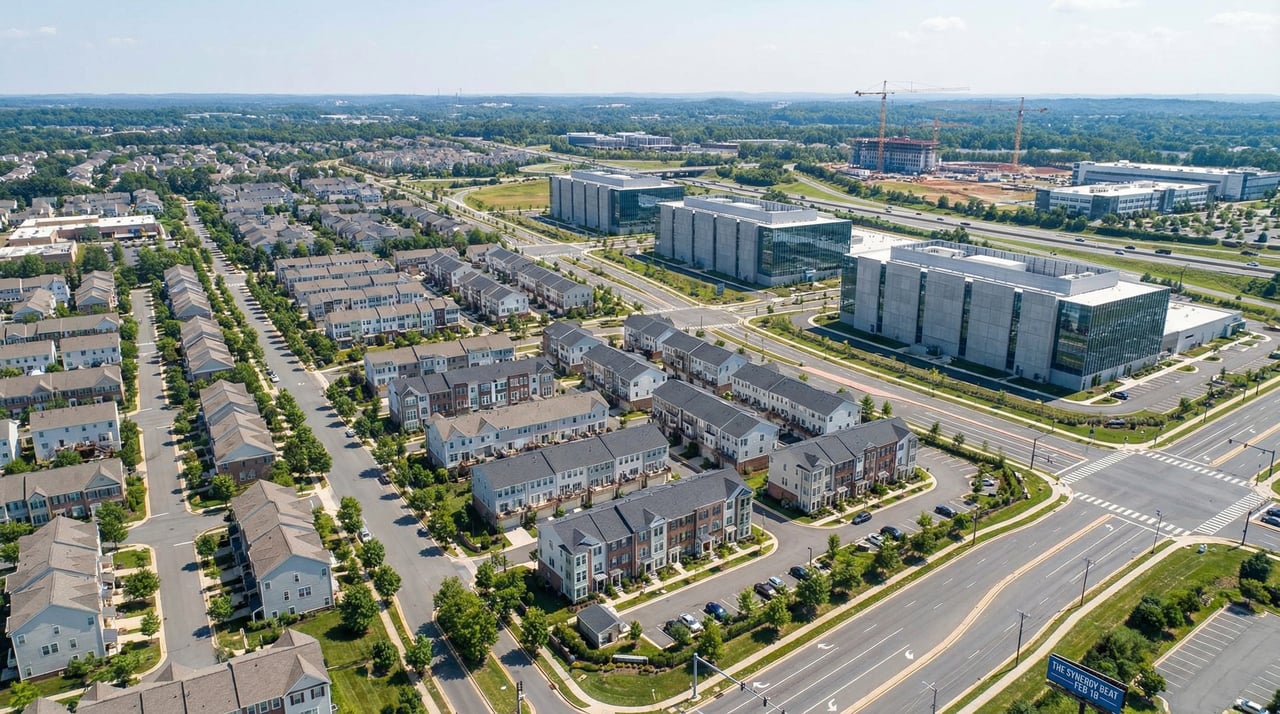
This week wasn’t about “market vibes.” It was about constraints. Northern Virginia’s AI data-center buildout is actively competing with housing for land and development capacity, tightening the supply story in a region that already behaves like a scarcity market. In DC, Congress stepping into local tax policy adds a new layer of governance risk—and governance risk gets priced into underwriting faster than people admit. Meanwhile, rate-sensitive demand is waking up again, but it’s doing so in short bursts rather than a broad-based rebound.
TOP HEADLINES (5)
-
Northern Virginia land is getting bid away from housing by AI data-center developers (WSJ)
-
Congress blocks D.C. tax policy in rare intervention, disrupting revenue planning mid-tax season (Washington Post)
-
Mortgage applications rise 2.8% WoW; refi demand up 132% YoY as rates dip (HousingWire / MBA)
-
Fed/Basel III capital design may become more mortgage “risk-sensitive” (LTV-driven) (Bloomberg)
-
Adani pledges $100B for AI data centers (global capex shock) (WSJ)
DETAILED REPORTS
1) Northern Virginia land is getting bid away from housing by AI data centers (WSJ)
What Happened (factual): The WSJ reports AI-driven data-center demand is pushing developers to pay housing-uneconomic prices for land in Loudoun and Prince William—citing offers up to $3M/acre, and noting 2022–2024 saw more data-center development than the prior nine years combined in the region.
Why It Matters (DMV lens): It’s a supply-side attack on future housing inventory in the exact geography that feeds high-income employment into the entire DMV housing ecosystem. When data centers win the land bid, the downstream effects are: fewer entitled residential parcels, slower subdivision pipelines, and higher finished-lot costs. That reinforces pricing power in existing neighborhoods even if demand cools.
Second-order effects you can actually act on:
-
Builders: land basis expands → either smaller product, higher prices, or fewer starts (all bullish for resale scarcity).
-
MoCo + DC spillover: if NoVA can’t add housing at scale, commute-driven households redistribute into adjacent nodes; that supports demand in MoCo corridors that hold school/commute value.
-
Local politics: the WSJ notes rising resident pushback and zoning shifts—policy risk is now a variable for data centers and housing (approvals get noisier, timelines lengthen).
Who It Impacts First (real sequence): Land sellers/land brokers → builders/developers → resale sellers (scarcity pricing support) → buyers (higher entry point, fewer choices).
2) Congress blocks D.C. tax policy in rare intervention (Washington Post)
What Happened (factual): Congress voted to block D.C.’s move to decouple its local tax code from federal tax cuts; the Post reports the change could cost D.C. ~$600M through 2029 and create tax-season disruption including potential refiling and processing delays.
Why It Matters (DMV lens): Markets price “risk” in two ways: interest rates and governance volatility. DC has always had federal oversight risk, but a high-profile intervention like this reminds investors and high-income households that local fiscal planning can get overridden. That matters for: (a) confidence at the margin, (b) municipal budget choices (services, incentives, enforcement), and (c) investor underwriting assumptions for rent growth and operating costs if the city adjusts elsewhere to fill gaps.
Where this hits real estate decisions:
-
DC condos: most sensitive to sentiment and “why take the risk?” narratives; anything that increases uncertainty can widen the buyer pool’s required discount.
-
Rental investors: if the city is squeezed, expect more aggressive enforcement and fee/tax creativity over time (not guaranteed, but historically common in budget stress cycles).
-
Retail corridors: if administrative disruption hits small businesses (filings, credits, cash flow), it trickles into leasing demand.
Who It Impacts First: DC small-business owners and high-income filers → DC condo sellers (liquidity) → rental underwriting (risk premium).
3) Mortgage applications rise; refi demand +132% YoY (HousingWire/MBA)
What Happened (factual): MBA data: applications up 2.8% WoW (week ending Feb 13), driven by lower rates; refinance activity up 132% YoY.
Why It Matters (DMV lens): A refi pop isn’t just “rates moved.” It’s a real-time indicator of consumer readiness. In the DMV, the people who can move the market are (1) equity-rich owners and (2) high-income professional households watching monthly payments. When refi demand jumps, it signals that those groups are re-engaging with financing—usually the first step before purchase activity accelerates.
The important nuance: refi strength can reduce supply. If owners can refinance into tolerable payments or restructure debt, they’re less forced to sell. That keeps inventory tight in Bethesda/Chevy Chase/North Arlington—exactly where buyers already compete hardest.
Actionable take: don’t treat “rates down” as universally bullish for buyers. In the DMV it can increase competition on the best listings while leaving flawed listings sitting. That’s how you get a market that feels hot and slow at the same time.
Who It Impacts First: Payment-sensitive buyers → listing agents pricing “A” inventory → sellers in premium school clusters (pricing power).
4) Basel III mortgage capital rules may become more “risk-sensitive” (Bloomberg)
What Happened (factual): Bloomberg reports the Fed is nearing a Basel III-related capital proposal, and Michelle Bowman highlighted approaches that would use loan-to-value (LTV) ratios to determine mortgage risk weights rather than a uniform treatment.
Why It Matters (DMV lens): This is structural. If capital treatment becomes more granular, lenders will eventually price credit differently across borrower profiles and property types. That can change the “shape” of demand in the DMV: higher-LTV buyers (often first-time buyers) could face worse terms relative to lower-LTV borrowers, reinforcing the advantage of equity-rich move-up buyers and investors with liquidity.
Second-order effect: it may widen the gap between:
-
Turnkey SFH (high down payments, strong credit → smoother financing) vs
-
Condo or borderline affordability deals (more payment sensitivity, sometimes higher LTV → more friction).
Practical implication for Synergy clients: underwriting needs to assume financing dispersion, not just a single “rate.” Negotiation strategy changes when buyer pools fragment.
Who It Impacts First: First-time buyers / high-LTV borrowers → condo sellers → entry-level MoCo/NoVA submarkets where the buyer pool is more payment constrained.
5) Adani pledges $100B for AI data centers (WSJ)
What Happened (factual): WSJ reports Adani announced $100B to build AI-focused data centers through 2035, scaling capacity via partnerships and power sourcing plans.
Why It Matters (DMV lens): This is a global signal that AI infrastructure is not a fad-cycle—it’s a capex supercycle. Even if the dollars are abroad, the knock-on effects hit the DMV through the supply chain: competition for electrical gear, generators, transformers, construction labor, and financing appetite for data infrastructure. That can raise costs and extend timelines for both residential and mixed-use projects in the DMV.
Who It Impacts First: Developers and contractors (costs/lead times) → builders (housing starts) → buyers (supply constraints).
INVESTOR INSIGHT OF THE WEEK
The real story is AI turning into zoning, land, and utility politics—which means it starts to behave like a housing variable. In the DMV, this pushes strategy toward scarcity assets with resilient demand (premium school/commute neighborhoods) and away from deals where returns require “everything going right” (thin cap-rate rentals, regulatory-exposed assets, or projects dependent on cheap land).
Bold takeaway: When infrastructure competes with housing for land, resale scarcity becomes the floor under pricing.
THE SYNERGY SYNTHESIS — MARKET VERDICT
Arlington / NoVA: AI infrastructure is tightening the development pipeline and raising the long-run scarcity premium. That supports resale pricing in established neighborhoods, but it also raises political and utility constraints that can slow any kind of building—including housing.
Bethesda / MoCo SFH: the best product still trades like a quality asset. Rate dips bring buyers back quickly; refinance pops reduce forced-selling; net result is continued tight inventory and fast competition for turnkey homes.
Opportunity: stale listings created by seasonal/weather timing (or mediocre presentation) become negotiable even while prime listings compete.
Risk: governance and compliance volatility—DC fiscal friction plus increased scrutiny/constraints around rentals and operating conditions.